
Bring the mess: how to get your money's worth from an expert
We wrote last week about working well with AI. This is the other half: how to actually get your money's worth from a human expert. It starts with the messy question you're embarrassed to ask, and with not treating the person like an AI.
Last time we wrote about working well with AI, and the core of it was preparation. The point we tried to drive home was: brief the machine carefully, feed it clean context, refine in rounds. Polish your inputs, and the output gets better. The more structured you are, the more clearly your goals are communicated, the more valuable your output will be. Fair enough.
Booking an hour with a human expert seems like it should work the same way: be well prepared, give them a clear task and the desired outcome. That’s how it should work, right? It doesn’t. In fact, the single most expensive mistake people make with experts is treating them like the machine: preparing a tidy version of the situation, presenting it smoothly, and getting back advice that fits the tidy version perfectly and their company not at all. Funny enough, we noticed there was a big shift here: many clients tend these days to mistake actual experts for an LLM (not really, but they sure treat them this way) — in the process forgetting the actual strength of human experts.
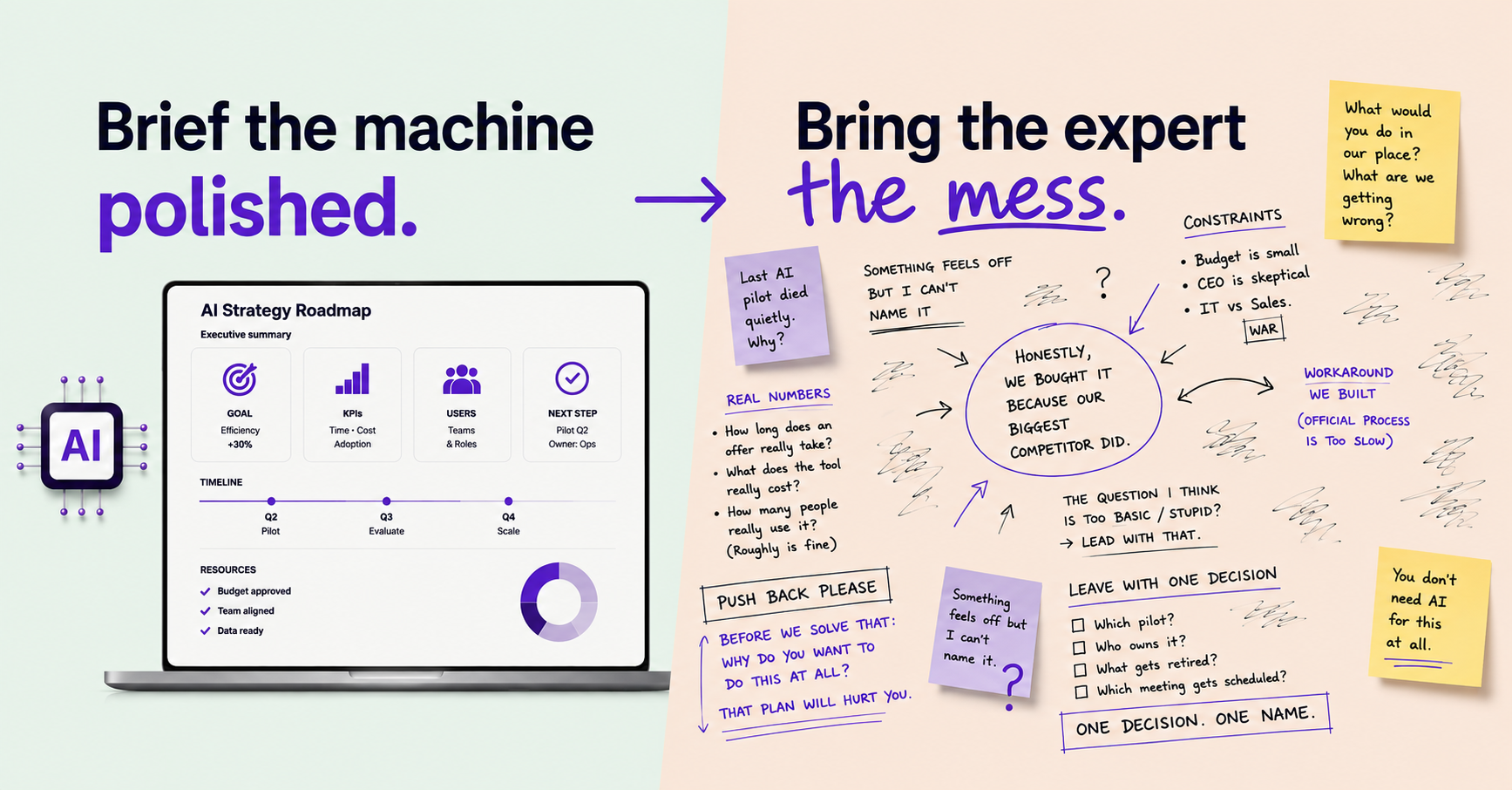
So here’s the counterintuitive rule this whole article hangs on: brief the machine polished. Bring the expert the mess. Your mess.
Why the mess is the material
An AI works with exactly what you give it, which is why you (hopefully) curate what you give it. An experienced human expert works differently: they pattern-match against everything they’ve seen and know, and the patterns hide in precisely the details you’d edit out when working with an AI. The little workaround your team built because the official process is too slow. The tool three people use that nobody approved. The fact that the last AI pilot died quietly and nobody wrote down why. The sentence you’d never put on a slide: “honestly, we bought it because our biggest competitor did.” All the messy truth.
To you, that’s embarrassing noise. To someone who has sat in eighty or more of these conversations, it’s the foundation of the diagnosis. Experts don’t bill you for reacting to your presentation. They don’t bill you because they want theatrics. Their value is noticing what your presentation was built to avoid, and they can only do that if you let the unpolished version into the room.
The corollary: the question you think is too basic, too simple, too stupid is the one to lead with. We hear it before almost every first conversation: “I don’t want to waste their time with beginner stuff.” Ask any of our experts which questions produce the best sessions. It’s those. The “advanced” questions about model optimization and some niche topics are usually the basic ones, postponed and compounded.
What to actually bring
Not a deck. Please, not a deck. Bring three things.
- One: the actual question as it actually lives in your head, unformatted. “Something about our AI setup feels off but I can’t name it” is a superb opening; a real expert will have it named within twenty minutes.
- Two: real numbers, even rough ones. How long an offer really takes (not how long you think it should take without looking embarrassing). What the tool really costs. How many people really use it. “Roughly” beats “confidential” every time; advice calibrated to vague inputs comes back vague, and then you’ve bought an expensive horoscope.
- Three: the constraint you’re tempted to hide. The budget is small. The CEO is skeptical. IT is at war with sales. Experts don’t judge constraints; they navigate them, and they can only navigate the ones they know exist. If you do not admit the actual problems, the recommendations will not be implementable.
Then: use the pushback
Here’s where working with a human pays for itself, and it’s the exact thing the machine won’t do. Somewhere in a good conversation, the expert will pause and push back. “Before we solve that: why do you want to do this at all?” Or, less comfortably: “That plan will hurt you.”
The reflex is to defend. The profit is in not defending, however. You’re paying precisely for the moment someone with no stake in your internal politics tells you the very uncomfortable thing; getting past it quickly is getting your money’s worth slowly. A practical trick we’ve seen good clients use: invite the counter-case explicitly. “What would you do in our place, and what do you think we’ve got wrong?” gives the expert permission to skip twenty minutes of politeness. Politeness is lovely at dinner. In a paid hour, it’s overhead.
And to be fair to the other side of the table: a good expert brings their own version of this honesty. They’ll tell you when something is outside their lane, when an hour won’t fix it, and when the answer is “you don’t need AI for this at all.” If you ever meet an advisor who has never once said any of those things, you’ve met a salesperson with a consulting title. And yes, there are enough consultants out there whose job description should be “pre-sales”.
Leave with one decision
The failure mode of expert conversations isn’t bad advice. It’s good advice that evaporates and can’t be applied — or won’t be applied. The session ends, everyone feels smarter, the notes join the graveyard folder, and three months later the situation is identical but with more documents nobody reads.
The fix is almost embarrassingly small: end every session by naming one decision. Not ten action items; those are how good intentions get buried in plural and eventually chaos. One thing that is now decided (which pilot, which owner, which tool gets retired, which meeting gets scheduled with which people) and one name attached to it. If you take a single habit from this article, take that one. An hour that produces one real decision beats a workshop that produces a beautiful document with ten semi-decisions.
The honest summary
Working well with AI and working well with an expert turn out to be opposite skills that serve the same goal. The machine needs your curation; the human needs your candor. The machine gives you draft zero to refine; the human gives you the pause, the pushback, and a name that stands behind the advice. Use both, in that order of comfort: let the machine handle what’s polished, and save the mess (the real question, the real numbers, the real constraint) for someone who has seen eighty versions of it and knows which one you are.
That conversation is an hour. The mess is welcome. Honestly, the mess is the point.
Just ask.
Just ask. A person, this time.
One hour with someone who has done it before, knows what it costs when it goes wrong, and is accountable for the answer.
Find an expert