
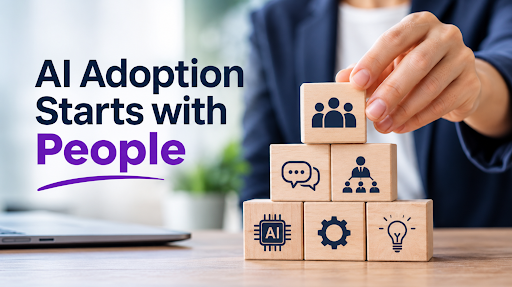
Your AI rollout isn't finished when the training ends
You've introduced AI tools, distributed licences and organised training sessions. Everyone knows that AI is becoming part of the business. But are people actually working differently? Change management expert Barbara Sennrich on why adoption starts with people.
You’ve introduced AI tools, distributed licences and organised training sessions. Everyone knows that AI is becoming part of the business. But are people actually working differently?
This is where many AI transformations run into trouble.
Introducing a new technology is one thing. Making it part of everyday work is something else entirely. And the difference often has less to do with the technology itself than with leadership, communication and the people expected to use it.
As Barbara Sennrich, founder of The Change Resilient Advantage and a verified v-oice expert, explains, change only becomes real when people actually start doing things differently.
The biggest mistake: confusing implementation with adoption
Many companies approach AI adoption by starting with the tools. They purchase licences, organise training and encourage employees to experiment with new applications.
These are important steps. But they don’t automatically create value.
Imagine a team that starts using AI to write reports and create drafts faster. Sounds like progress, right? But what happens if nobody has clarified who checks the results, who approves the content or how the new process fits into existing workflows?
The team might produce more content in less time, but that doesn’t necessarily mean the business is working better.
As Barbara points out, companies need to ask a different question first:
What business problem are we actually trying to solve with AI?
Instead of starting with the technology, start with a concrete challenge. Where are processes unnecessarily complicated? Which tasks take up too much time? Where could AI genuinely make work easier or improve results?
The answers often come from the people who do the work every day.
Start with one use case, not ten
AI creates plenty of opportunities, and it is tempting to pursue several of them at once. But trying to change everything simultaneously can quickly become overwhelming.
Barbara sees the same principle applying to both SMEs and large corporations: start small, define what success looks like and learn from the results.
A practical starting point could be:
- Identify one specific business challenge.
- Involve the employees who understand the process.
- Define what should improve and how you will measure it.
- Give the team time to experiment with AI.
- Review the results and adjust the approach.
This creates a foundation that can be expanded over time.
The size of the company doesn’t change this principle. Even organisations with significant resources can lose momentum when they launch too many initiatives without properly testing how they work in practice.
Why people react differently to AI
Not everyone experiences technological change in the same way.
Some employees see AI as an opportunity to reduce repetitive tasks, explore new possibilities and focus on more meaningful work.
Others may wonder whether their knowledge will still be relevant, whether their role will change or whether they can keep up with the speed of technological development.
And these concerns deserve to be taken seriously.
Barbara explains that people don’t evaluate change purely rationally. They also consider what it means for their sense of security, influence and belonging.
The same AI implementation can therefore feel like an exciting opportunity to one person and a threat to another.
That’s why simply telling employees that AI is the future rarely works. Leaders need to understand what is actually behind people’s concerns.
Is there a lack of clarity? Fear of losing something familiar? A lack of skills? Or simply not enough time to learn something new alongside existing responsibilities?
The answer determines what kind of support is needed.
What looks like resistance might actually be a lack of time, trust or clarity.
Leadership starts with listening
One of Barbara’s strongest messages is that leaders should stop assuming that announcing a decision is enough to make change happen.
A strategy might be clear to management because they have spent months discussing it. But employees may only hear about it when it is officially announced.
Expecting everyone to understand, accept and embrace the change immediately is unrealistic.
Instead, leaders need to create space for questions, feedback and honest conversations.
That means:
- Explaining the reasons behind the change repeatedly.
- Being transparent about what has already been decided and what is still open.
- Listening without assuming you already know the answers.
- Taking concerns seriously rather than immediately trying to convince people.
- Giving employees opportunities to influence how new ways of working are introduced.
Communication is not a one-time announcement. It is an ongoing process.
And leaders don’t need to have every answer. Sometimes the most important thing they can do is ask the right questions.
Three human skills that become even more important with AI
As AI becomes more capable, human expertise doesn’t become less relevant. In many situations, it becomes even more important.
Barbara highlights three abilities that organisations should actively develop:
1. Critical thinking
AI can generate information, ideas and recommendations at incredible speed. But someone still needs to evaluate whether the results are correct, relevant, appropriate and ethically acceptable.
Without critical thinking, people risk accepting AI-generated answers without questioning them.
2. The ability to learn
AI is continuously changing what people do at work. Tasks that are important today may look very different tomorrow.
Employees need opportunities to develop new skills, adapt and discover where their experience can create the greatest value.
3. Collaboration
Successful AI adoption requires people to share experiences, exchange ideas and learn from one another. Teams also need to develop new ways of working with AI rather than treating it as a standalone tool.
These skills cannot simply be introduced through another software licence. They need to be developed through practice, exchange and support.
Change happens in everyday work, not in presentation slides
A new strategy can look convincing on paper. A technology can work perfectly in a demonstration. And employees can complete every training session.
But none of this guarantees that the organisation has actually changed.
Real progress happens when people have the time, clarity, resources and support to work differently.
For leaders, that means looking beyond whether a tool has been introduced. They need to ask whether it is being used, where difficulties arise, whether processes have improved and what needs to change next.
And perhaps most importantly, they need to involve employees early enough to shape the transformation together.
Barbara’s advice is simple:
Don’t just inform people about change. Involve them in making it work.
Because successful AI adoption is not only about what technology can do. It is about what people can achieve when they have the right support to use it.
Just ask. A person, this time.
Introducing AI, navigating organisational change or helping your team adapt to new ways of working? Sometimes the next step isn’t another tool or training session. It’s a conversation with someone who has guided organisations through change before.
Find the right expert on v-oice.
This article is based on a LinkedIn Live session on 29 October 2026, hosted by v-oice founder Aileen Zumstein with change management expert Barbara Sennrich.
Just ask. A person, this time.
One hour with someone who has done it before, knows what it costs when it goes wrong, and is accountable for the answer.
Find an expert